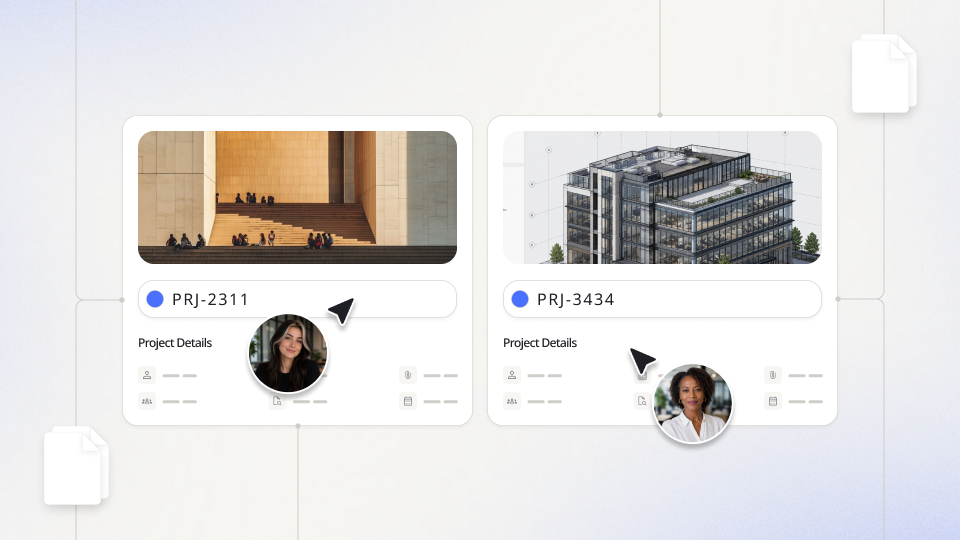
Ever notice how the firms with the clearest view across ten or twenty active projects are not the ones holding more status meetings? They just do not need to. A project's status is not something a manager has to go collect, because it already exists.
Actions, deadlines, contractors and documentation live in one connected system instead of being scattered across spreadsheets, inboxes and personal notes. Everything else, more reporting cadence, more check ins, more reminders, is just a workaround for a structure that was never built to answer the question in the first place.
Spreadsheets and email got the industry this far
Give the current approach its due. Excel is flexible, every project manager already knows it, and for a single project with a handful of milestones, a well-kept spreadsheet works fine. Email is the same story. It is where clients, contractors and consultants already communicate, so it is the path of least resistance for capturing a decision in the moment.
The strain shows up the moment a firm is running several projects at once, each with its own disciplines, contractors and review cycles. Firms spend nearly half their time on activities other than design, and more than half say at least a quarter of their projects go over budget. Spreadsheets do not cause that on their own. They simply were not built to hold a live, shared picture of a portfolio, so each project manager ends up keeping their own version, and the real status only appears once someone spends a day pulling all of them together.
A status report is not the same as a status
Here is the distinction: a project having a status and someone compiling a status report are two different things. Most firms can answer "where do things stand" eventually. Ask on a Tuesday afternoon without notice, and the honest answer is usually "let me check with the team and get back to you."
That gap is not a communication problem but a structural one. When actions, owners, deadlines and documents are not connected to the same project record, status has to be reconstructed by hand every time someone asks for it, whether that someone is a client, a managing partner or an auditor. This is exactly the kind of gap a business process automation software is built to close, by giving every project one shared record instead of a dozen private ones.
Where Ninox can add value
Ninox is not a replacement for the CAD, BIM or document management systems an engineering firm already relies on for design work. It sits alongside them, as the layer that handles the operational side those systems were never meant to cover: tasks, ownership, deadlines, decisions and coordination across every active project.
Instead of a spreadsheet someone has to update by hand or a generic task board with no connection to the actual project, project managers can use AI to build a shared data model that links every action directly to its project, its owner and its deadline. A flagged issue does not sit in a meeting note. It routes to the person responsible, with a deadline attached and a record of who resolved it and when.
Because the data model is built on a low-code platform with a drag and drop builder and a scripting layer underneath, a structural engineering review process and an architecture handover process can run through the same system without either team being forced into the other's workflow. Document decisions, contractor communications and change history stay attached to the project record they belong to, with full version history and an audit trail, so nothing depends on one person's inbox or memory.
The bigger picture
More of the industry is moving in this direction, toward business process automation software built for exactly this kind of coordination. The global project management software market is projected to grow from $10.51 billion in 2026 to $16.87 billion by 2030, driven in part by firms replacing manual, disconnected reporting with a low-code platform built for real time visibility.
For engineering consultancies and architecture firms managing an expanding project portfolio, that shift is less about adopting new technology for its own sake and more about finally being able to answer a simple question without a day of chasing spreadsheets first.
Take the next step. Start building for free with Ninox.
Let's figure it out together.