Filing an incident report and doing something about the incident are two different things. Most manufacturing plants have a way to log a near miss or an injury. A binder at the safety office, a form on a clipboard, a spreadsheet someone updates once a week. Far fewer have a system that guarantees what gets logged gets investigated, assigned to someone, and closed out before it happens again. The report exists. Whether anything followed from it is a separate question, and on most shop floors, nobody can answer it quickly.
Paper forms and spreadsheets are fast for a reason
A paper form or a laminated card at a workstation asks almost nothing of the person filling it out. No login, no training, no waiting on IT. For a small operation logging the occasional incident, that simplicity is exactly what keeps reporting from becoming another chore workers skip.
Manufacturing carries one of the highest injury rates of any sector. Business Insurance put the industry's total recordable case rate at 2.7 per 100 full-time workers for 2024, above the private industry average of 2.3. Layer near misses on top of recordable injuries and the volume only grows. Herbert Heinrich's century-old safety pyramid research, later expanded by Frank Bird, found that for every serious injury, dozens of minor incidents and hundreds of near misses came before it.
Safety researchers still debate the exact ratios, but the underlying pattern holds up: near misses are the earliest warning a plant gets, and a paper log that nobody reviews on a regular cadence throws that warning away.
Logging an incident and closing one out are two different things
A completed incident form proves something happened. It does not prove anyone investigated why, assigned a corrective action, or confirmed the fix got made. A form filled out on a clipboard and filed in a binder has no owner, no deadline and no way to flag itself when three weeks pass with nothing done.
That gap is where the next incident comes from. A guard gets reported as missing on a machine, the form goes into the stack, and six weeks later a different shift gets hurt on the same equipment because the report never turned into a work order. Nobody ignored the report on purpose. There was simply no system connecting the report to the fix.
EHS Today's coverage of a six-year analysis by ISN found more than 24,000 serious injury and fatality cases across 127,000 recordable incidents, a pattern that only became visible once the reports were tracked and analyzed together instead of sitting separately in individual plant files. A low-code platform that keeps every report in one connected system is what makes that kind of pattern visible before the next serious injury, not after.
From paper trail to corrective action
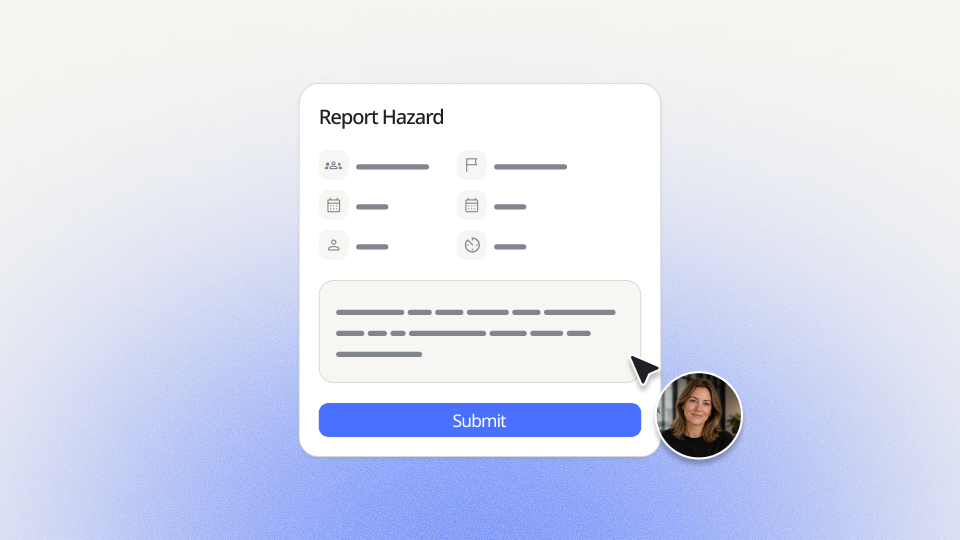
This is exactly the gap a low-code platform closes. Instead of a paper form that ends its life in a binder, safety managers can use AI to build a digital incident report that captures the details on the shop floor and immediately creates a linked record with an owner, a severity level and a deadline attached.
Because it runs on low-code, EHS teams can shape the reporting process around their own plant instead of forcing every incident type into a rigid template. A flagged hazard can trigger an automatic notification to the responsible supervisor as soon as it is logged, using scripting and conditional logic built directly into the data model.
Corrective actions stay linked to the incident that created them, with a visible status and a full audit trail, so a safety manager checking in on Friday can see exactly which items are open, which are overdue, and which machine keeps generating the same report. Generating the monthly compliance report pulls straight from that same data, instead of someone reconstructing it from a stack of forms.
Plants that want to skip the blank page can start with the Incident Management template. It gives every report a responsible person, a due date, a category and a priority from the moment it is logged. Each safety manager or supervisor opens a personal dashboard showing their assignments and which incidents are urgent, in progress or resolved. From there, the template can be shaped around the plant's own incident types, severity levels and approval steps.
What separates a safe plant from a quiet one
The plants that consistently outperform their industry on safety are not the ones with the most forms. They are the ones where reporting a hazard reliably leads to a fix, which is what keeps workers reporting in the first place.
A low-code platform makes that possible precisely because the reporting process never has to stay fixed once it is built. Closing that loop is less about adding paperwork and more about making sure a report never has to be chased down to find out what happened to it.
Take the next step. Start with the Incident Management template and turn your next incident report into a closed one.