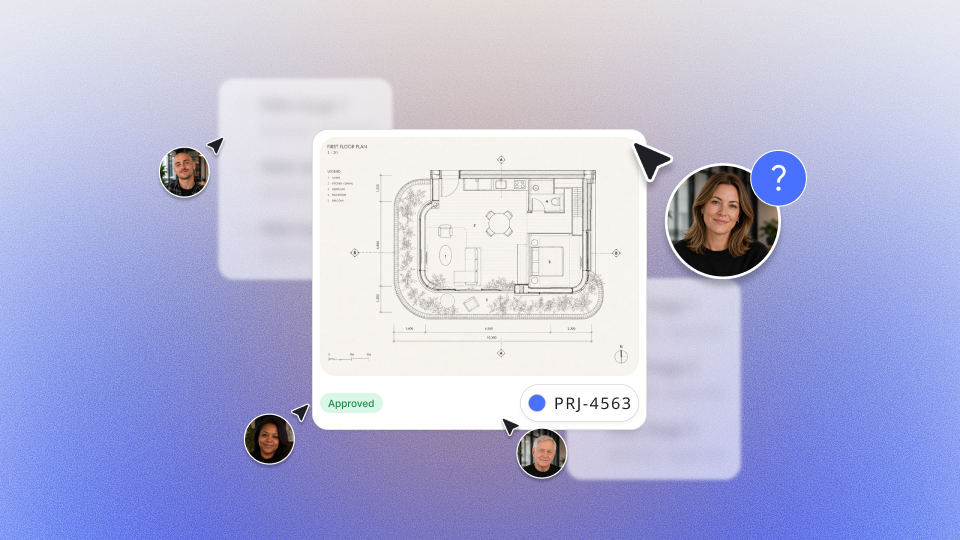
Architecture firms rarely lose a drawing. They lose the reasoning behind it. Six months after a design decision, a client, a contractor or an auditor asks why a wall moved, why a material changed, or how a compliance issue got resolved, and the answer is not attached to the project. It is buried three inboxes deep in an email thread nobody thought to save anywhere else. The file survives. The decision behind it does not.
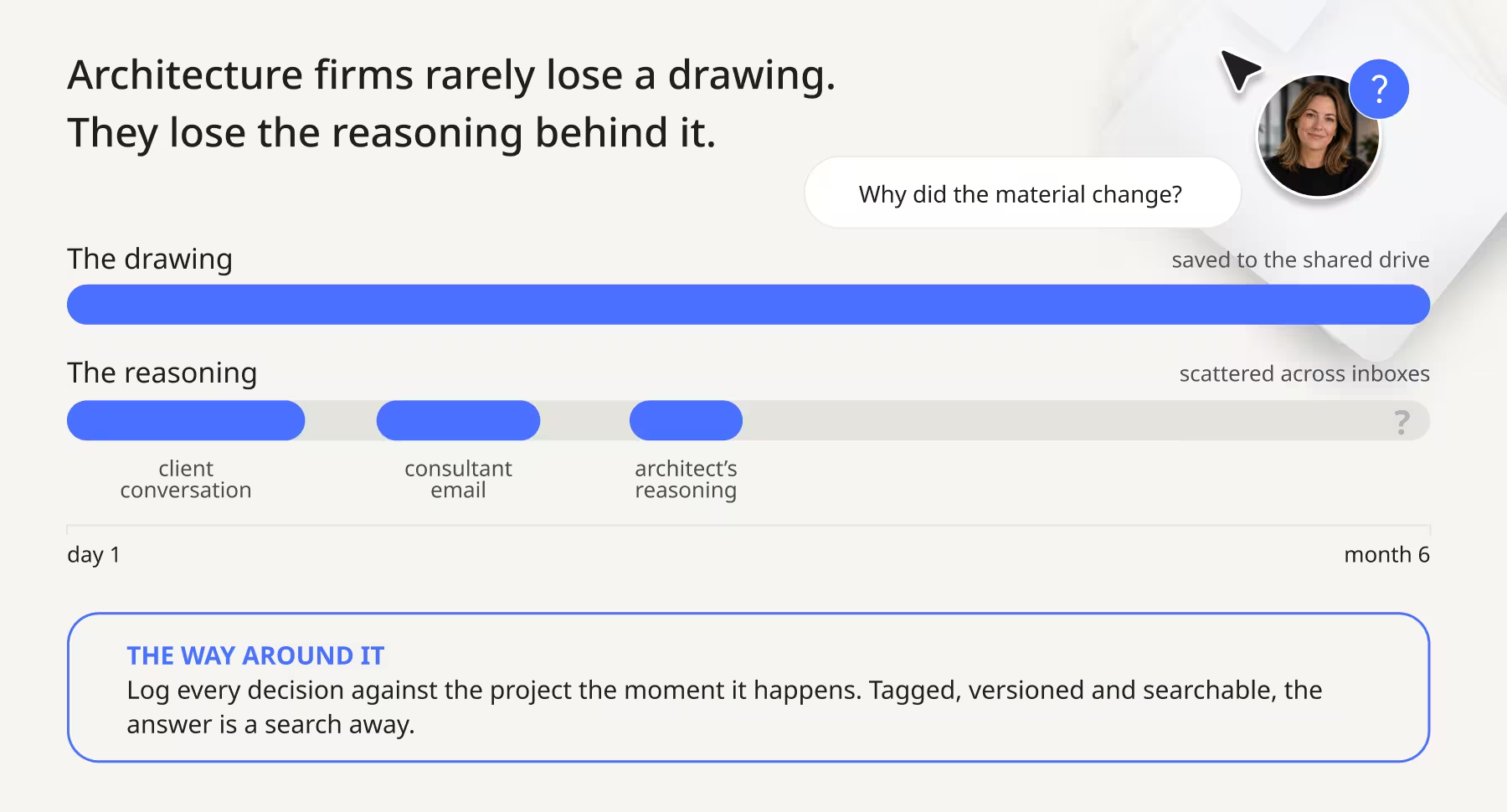
The infographic below tracks a drawing and its reasoning from day one to month six, and only one of them is still there when the question comes.
Shared drives and email do exactly what they were built for
Give the current setup its due. A shared drive is simple, familiar and universally understood, and for storing a finished set of drawings, it works fine. Email is the same story. It is where clients, consultants and contractors already talk, so it is the natural place for a decision to first get made.
The strain shows up later, when someone needs to reconstruct why. Knowledge workers spend an average of 28 hours a week writing emails, searching for information and collaborating internally, nearly three quarters of the working week. A shared drive stores the final drawing. It does not store the client conversation that led to the revision, the consultant email that flagged the code issue, or the reasoning the project architect used to resolve it. That context lives somewhere else entirely, disconnected from the file it explains.
Storing a file is not the same as being able to trace a decision
A folder full of PDFs proves work was done. It does not prove why it was done a certain way, or who approved it, or when. Those three questions are exactly what comes up when a client pushes back, a contractor disputes a change order, or years later, a claim gets filed.
That gap has real teeth. An architect's strongest defense is not the design itself, it is the contemporaneous, documented record of the decisions behind it. A firm that can produce that record quickly is in a fundamentally different position than one that has to reconstruct it from memory and a search through years of inboxes.
Adding value with a low-code platform
Ninox turns the record-keeping around a project into something a firm controls. A material substitution approved over email, a code question resolved with a consultant, a client sign-off on a revision, none of that has to live in someone's personal inbox waiting to be found later. Project managers and architects use AI to build a project record where every decision, document and approval attaches directly to the project it belongs to, tagged, versioned and searchable from day one.
A material substitution approved over email gets logged against the project the moment it happens, not reconstructed from memory when someone asks about it later. Because the underlying data model is built with a drag and drop builder and a scripting layer, firms can shape this record around their own review and approval process instead of forcing every project into a rigid template.
When someone asks why a decision was made, the answer is a search away, not a research project.
Built for scrutiny, not just storage
This matters more as compliance expectations rise. Ninox is built on GDPR and ISO 27001 aligned infrastructure, so the same record that answers a client's question can also stand up to an audit or a claims review, without a firm needing to bolt on a separate system just to prove it did the work correctly.
Take the next step. Start building for free with Ninox.
Let's figure it out together.