
Most teams assume scripting is for complex problems, so they never try it on the simple ones. But the logic that runs a business is rarely hard. Someone creates a record, and three other things need to happen next. When people handle those steps by hand, they forget them or do them slightly differently each time. On a low-code platform like Ninox, a few lines of script attached to the right moment make them happen the same way, every time.
Doing it by hand works until it doesn't
Manual processes deserve some credit. They need no setup, and a person handling each step can spot the odd case a rule would miss. For a team processing a handful of records a week, a checklist is often enough.
The problem is volume and memory. As records multiply, every follow-up step becomes one more thing someone has to remember, and consistency quietly erodes. The people doing the work pay for it too, because repetitive steps eat the time they could spend on work that needs their judgment. The real distinction is between logic people have to remember and logic the system remembers for them.
Three moments cover most of what your business needs
In Ninox, logic lives right on the record. Every table has three built-in moments: when a record is created, when it's updated, and when it's deleted. Attach a script to any of them and it runs automatically. Let's take an animal shelter that needs a solution for their business as an example.
When a new adopter record comes in, nobody should have to remember to open an adoption request. The create script builds the linked request automatically, so one action triggers the next.
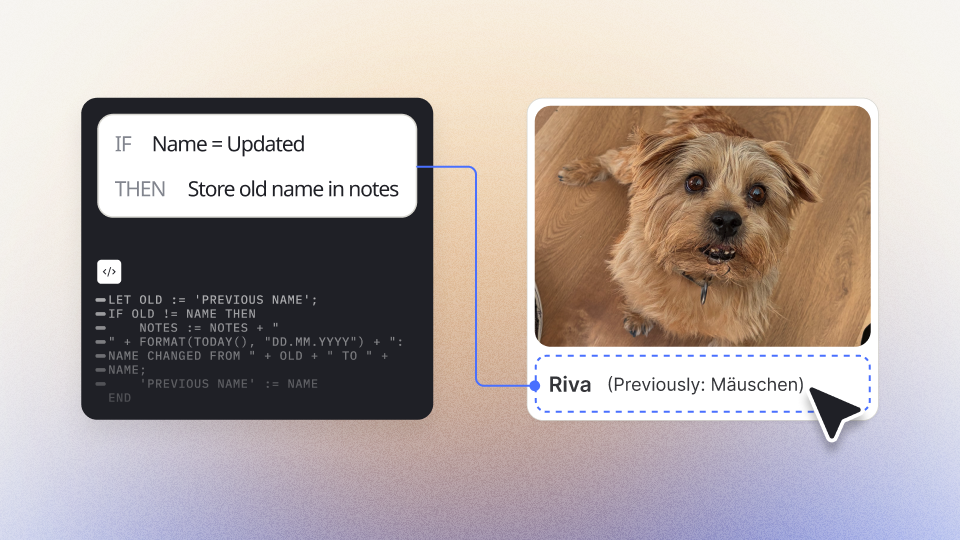
When a dog's name changes, you don't want to lose the old one. The update script adds a line to the notes with the previous and new name, so nothing gets overwritten. You don't even have to write that script from scratch. Because Ninox is AI-native, you can describe the rule in plain language and let the AI help you build it, then refine it from there.
Delete is the one people underestimate. Removing a dog record rarely affects just that record. Instead of cleaning up by hand, the delete script switches every linked adoption request and note to "Archived," so the history stays intact instead of disappearing.
Scripting is a sentence, not a software project
The biggest barrier to scripting is the belief that it's only for developers. Create, update, and delete cover most of what teams need, and each script is small enough to read at a glance. That's the difference between a low-code platform and a development project: your team sets the rules without waiting on anyone else to build them.
Getting started doesn't require a course. The Ninox docs walk through scripting step by step, so you can build a script in small pieces and see how the parts work together. For a visual walkthrough, Nils, our AI Product Expert, started covering some of the basics on the Ninox YouTube channel.
Set it once and the system does the remembering
Every script you attach is one less step a person has to carry in their head, and one less place for your data to drift. Start with the follow-up task your team forgets most often, attach it to the right moment, and let the low-code platform handle it from then on.