If you're evaluating an Airtable alternative right now, price is probably what brought you here, but it shouldn't be what decides it. Since September 4, 2026, Airtable belongs to Bending Spoons, and the important question to ask isn't whether your bill will change. It's who sets the terms for your data, and where that data lives while they do. The platform you choose next should put both answers back in your hands.
Most Airtable teams like the product, and that's the point
Airtable made relational data approachable for people who never wanted to touch a database, and more than 500,000 organizations use it today, according to Bending Spoons' closing announcement. Its interface designer is polished, and its native integrations with Slack, Salesforce, and Jira cover a lot of ground.
That's why most teams in Germany, Austria, and Switzerland who start looking around aren't unhappy with the product. They're unhappy with not knowing what comes next. That's a different problem, and it calls for a different kind of answer.
An ownership change is a fact, a price increase is not
Bending Spoons completed the acquisition on September 4, 2026, its first deal since listing on Nasdaq in July. It said it plans to invest heavily in Airtable's product, support, and go-to-market. No price change for Airtable has been announced.
Also on the record: Bending Spoons has raised prices at products it bought before. The Pragmatic Engineer reports that Evernote Pro customers who paid $37 a year before 2023 were paying $250 a year by 2026. Whether anything similar happens at Airtable is anyone's guess, and we won't guess.
Ops and IT leaders don't get paid to guess, though. They get paid to plan. That's the distinction this whole comparison hangs on. Most reviews compare features, but the real decision is about terms. Features tell you what the software can do today. Terms tell you where your data sits and what forces an upgrade, and they can change without asking you. Your database shouldn't be a bet on an investor's strategy.
Airtable GDPR questions start with the server region
By default, Airtable hosts data on US-based AWS servers. European data residency exists, but only on the Enterprise Scale plan. Even then, Airtable's own FAQ notes that user, login, and metadata stay in the US. Airtable secures those transfers with EU Standard Contractual Clauses, which is a legitimate mechanism. Whether it's enough for your organization is a call for your data protection officer.
One more detail worth knowing before you sign: once data residency is enabled, Enterprise Scale customers can't downgrade to another plan at the end of their contract.
Ninox takes the question off the table. The server region is Germany on every plan, including the free one, so a five-person team gets the same data location as an enterprise rollout (Ninox pricing). Ninox is ISO 27001 certified and GDPR compliant. Your contract is with a German company, and support speaks your language. For a low-code platform that carries your core operations, that's the baseline, not an add-on.
Planning gets easier when limits don't force your hand
Airtable's plans come with record and attachment caps. According to its pricing page, once you hit the limit, you can't add new records or attachments until you upgrade. That's a reasonable model, and plenty of software works this way. The catch is timing: the upgrade happens when your data grows, not when your budget cycle says it should.
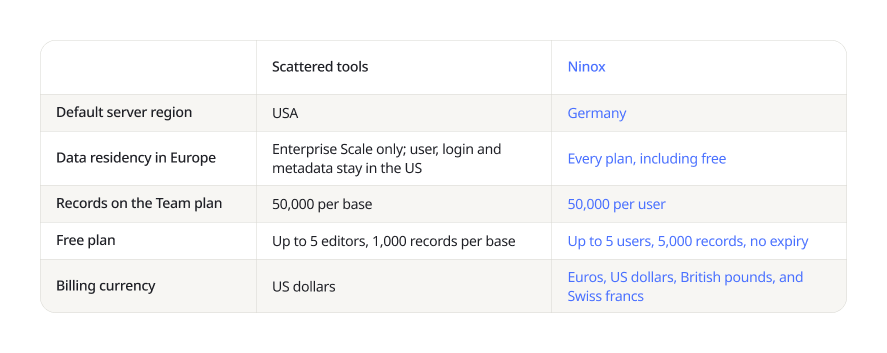
Ninox counts capacity differently, which makes a straight comparison tricky. On the Team plan, Airtable allows 50,000 records per base, while Ninox allows 50,000 per user. On Business, it's 125,000 per base against 250,000 per user. Per base and per user aren't the same unit, so check which one fits the shape of your data.
On the Enterprise plan, Ninox has no usage limits beyond data storage and AI capacity. AI comes with an included allowance, and usage beyond it is billed, which is how most of the market handles it. Billing is in euros, so there's no currency swing on top of your license. The point isn't that Ninox is cheaper per seat. It's that total cost of ownership becomes something you can put in a budget and defend. Here is a small comparison table:
Want the full picture? See the full Ninox vs. Airtable comparison page.
Switching shouldn't mean starting from zero
The biggest reason teams stay put isn't loyalty. It's the fear of rebuilding everything. Ninox works with the views Airtable users already know, including table, form, kanban, calendar, and map, plus a Gantt view for project timelines.
Ninox runs in the browser on desktop, tablet, and smartphone (Ninox FAQ), so the team in the field works from the same data as the team at the desk. You don't have to plan the move alone, either. We help you migrate, and how much work that takes depends on your base, which is exactly what the switch check is for. That flexibility is what makes Ninox worth switching to: you shape it around your process instead of rebuilding your process around it.
German companies want their data at home
This isn't a niche concern. In a survey of 603 companies in Germany, 97 percent said server location plays a role when they choose a cloud provider. Every single respondent said they'd prefer Germany. The market has made up its mind about where data should live. The open question is whether your database vendor agrees.
The moment that matters is your next Airtable renewal, and it's easy to get caught flat-footed by it. In a 30-minute switch check, we can show you what your Airtable base looks like in Ninox and how much work the move would be. You walk into the renewal with a real alternative on the table, and you stay in the driver's seat. Enterprise pricing is on request, and we'll go through it together.
Take the next step.
Let's figure it out together.